

Summer 2026 (May-June)
This summer, Mary and Garrett are working with Dr. Farone on disease and infestation testing and maintenance methods. Most of this work is through collaboration with Apisense, an organization based in Poland that has developed sensor equipment that connect to a computer hub placed near the apiary that sends data to our phones via the Apisense app. We have been sent some prototype sensors to use in our apiary that will be helpful in managing data from our own varroa tests (via powdered sugar rolls), some new nosema tests, and more. Through collecting and synthesizing the data collected in the hives and any extra information and pictures submitted by us, the Apisense AI model can estimate and report on the health of each hive being recorded. This will allow us to digitally store and manage some records, lead to more disease testing later this Summer and Fall, and allow us to see if a system using these types of sensors is viable in an apiary.
As mentioned above, one part of the partnership with Apisense is nosema testing. To perform the tests, we had to collect 25 honey bees from each of the 5 hives with Apisense sensors in them. Once the samples were collected, they were mixed with some water and crushed into a homogeneous mixture (or as close to one as is possible with crushed bees) and looked at under a microscope. While we did not count the nosema found in our samples, we took pictures of our slides and uploaded them to the Apisense app where the AI and the staff in Poland are going to run through them and count for us. This test will be repeated 2 more times for each hive during this partnership with Apisense.
One challenge we have faced this summer followed an injury experienced by Dr. Farone early in our research schedule. Once we understand what the circumstances were, Mary and Garrett were sent to the apiary to perform most of the regular hive inspections across our 13 hives and 2 splits at the time. Jumping headfirst into full hive inspections and apiary management was a quickly realized responsibility, but they were not alone, as Dr. Farone was on a video-call during the 2 weeks she was unable to physically make it up to the apiary. As she healed, we eventually were all back with the bees and began to prepare for the installation of the Apisense sensors.
Some other honey bee projects that Mary and Garrett have been up to over the first half of this summer include providing treatment for suspected EFB, monitoring and managing the sick hives, constructing a digital hive inspection notebook in Microsoft Excel, and some minor updates to the our website (particularly to the mobile view)!
Pictures!

Installation of Apisense sensor on the side of a frame
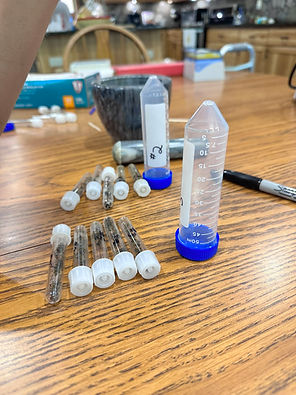
Nosema Testing: Collected (thawed from frozen) bee samples

Nosema Testing: Micropipetting the bee mixture on the hemocytometer slide

Mary and Garrett performing a hive inpection (looking for a bee with a varroa mite on it that we saw briefly)

Nosema Testing: Crushing bees in a mortar and pestle

Nosema Testing: Nosema found under the microscope!
Summer 2026 (July-August)
Stay tuned!